


Introduction
During the development of modern oral dosage forms such as orally disintegrating tablets (ODTs), chewable tablets, oral granules, and oral suspensions, taste masking of bitter active pharmaceutical ingredients (APIs) remains a major challenge for R&D teams.
Many active ingredients, including Ibuprofen, Clarithromycin, Azithromycin, Cetirizine Hydrochloride, and Dextromethorphan, possess a strong bitter taste that can significantly affect patient compliance.
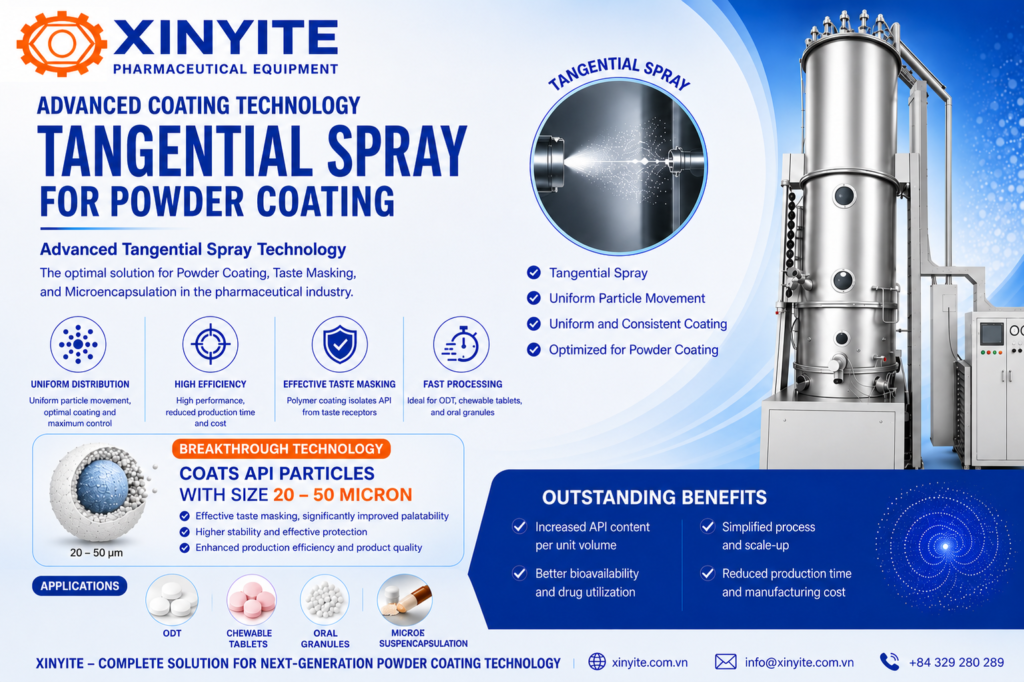
To address this issue, Powder Coating, Taste Masking, and Microencapsulation technologies are increasingly being applied throughout the pharmaceutical industry.
In particular, Tangential Spray technology integrated into a Multifunction Fluid Bed Processor enables the direct coating of micronized API particles ranging from 20–50 μm with functional polymers, creating an effective taste-masking film layer.
What is Powder Coating?
Powder Coating is a technology that directly coats the surface of active pharmaceutical ingredient (API) particles or API-loaded microparticles with one or more layers of functional polymers.
Unlike conventional pellet coating technology, which uses sugar spheres or MCC pellets as starter cores, Powder Coating utilizes the API particles themselves as the core material.
The coating process includes:
- Loading the API powder into the equipment.
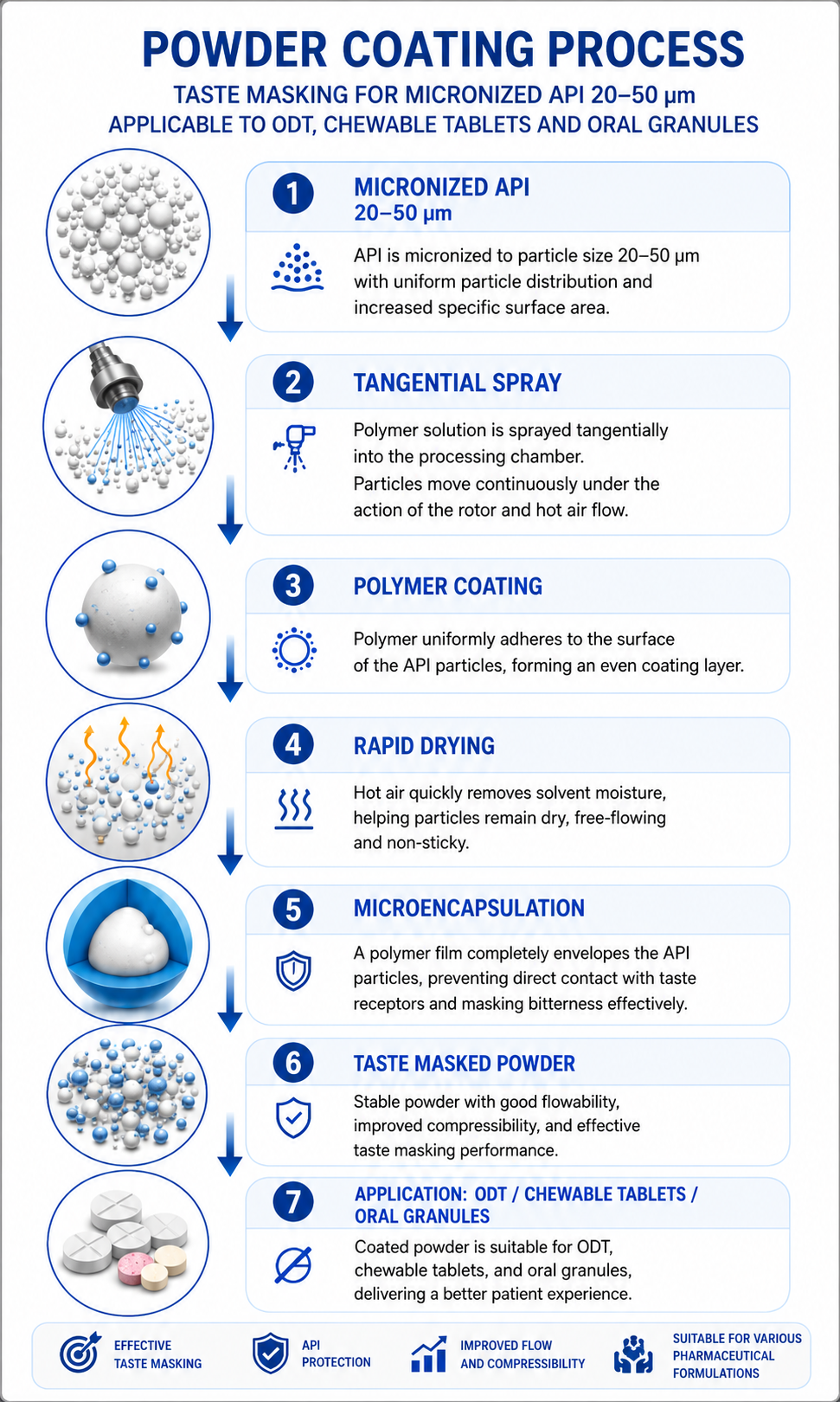
- Creating stable particle movement.
- Spraying the polymer solution.
- Polymer adhesion onto the particle surface.
- Instant drying using heated air.
- Formation of a uniform film layer around each particle.
Advantages
- Taste masking: Reduces the bitter or unpleasant taste of APIs.
- Controlled drug release: Regulates the release rate of APIs within the body.
- Improved stability: Protects APIs from environmental factors such as moisture and light.
- Enhanced flowability: Improves powder flow characteristics.
- Formulation flexibility: Supports the development of ODTs, chewable tablets, granules, and other dosage forms.
As a result, the API particles become fully microencapsulated, minimizing direct contact with taste receptors in the oral cavity.
Taste Masking Mechanism Using Polymer Coating
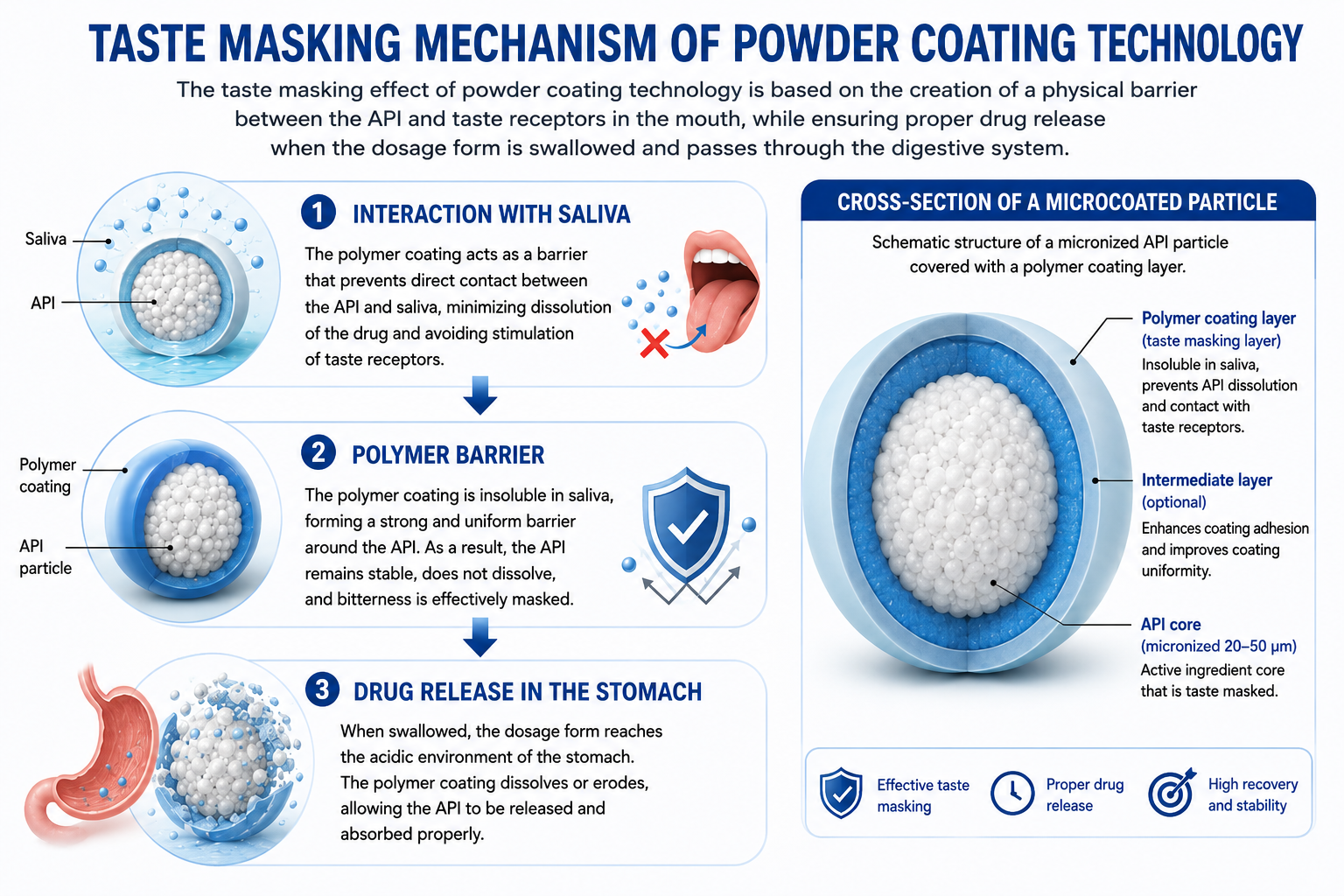
| The principle of taste masking is based on creating a polymer film barrier that separates the active ingredient from saliva.
When the patient holds the dosage form in the mouth:
After swallowing:
Commonly used polymers include:
In addition to taste masking, the coating layer also provides:
|
 |
Why is Tangential Spray Suitable for Powder Coating?
When particle size decreases below 100 μm, coating becomes more challenging due to:
- Particle agglomeration.
- Particles being easily carried into the filter bags.
- Non-uniform coating layers.
- Low product recovery rates.
Tangential Spray (Rotor Processing) was specifically developed to process these fine particles.
During operation:
- A high-speed rotor generates centrifugal motion.
- The polymer solution is sprayed tangentially.
- Heated air continuously dries the particles.
- Particles are mixed uniformly throughout the process.
As a result:
- High coating efficiency.
- Excellent coating uniformity.
- Reduced agglomeration.
- Improved product recovery.
- Better control of the microencapsulation process.
Comparison Between Powder Coating and Conventional Pellet Coating
| Criteria | Powder Coating (Tangential Spray) | Pellet Coating |
|---|---|---|
| Core Material | Micronized API (20–50 μm) | Pellets, sugar spheres, starch-based cores, etc. |
| Particle Size | Small and uniform after coating | Larger and more variable |
| Drug Loading | Higher drug content per unit volume | Lower, depending on the core material |
| Excipient Usage | Primarily concentrated in the coating layer | Includes both the core and coating layer |
| Suitability for ODTs | Highly suitable, with rapid drug release | Suitable, but requires optimization |
| Manufacturing Cost | Typically lower, with a simpler process | Typically higher, with a more complex process |
For many years, taste-masking technology primarily relied on coating active ingredients onto sugar spheres or MCC pellets.
However, the current trend is shifting toward:
Micronized API → Polymer Coating → Finished Product
This approach offers several advantages:
- Higher drug loading.
- Reduced excipient usage.
- Simplified manufacturing process.
- Improved production efficiency.
- Ideal for ODT and chewable tablet formulations.
This is also one of the key development directions in modern Particle Engineering and Advanced Drug Delivery Systems research.
Coating Micronized APIs (20–50 μm) Using Xinyite’s Tangential Spray Technology
One of the greatest challenges in powder coating technology is processing active pharmaceutical ingredients with extremely small particle sizes. When particle size falls below 100 μm, particularly within the 20–50 μm range, issues such as agglomeration, wall adhesion, filter bag losses, and poor coating uniformity frequently occur.
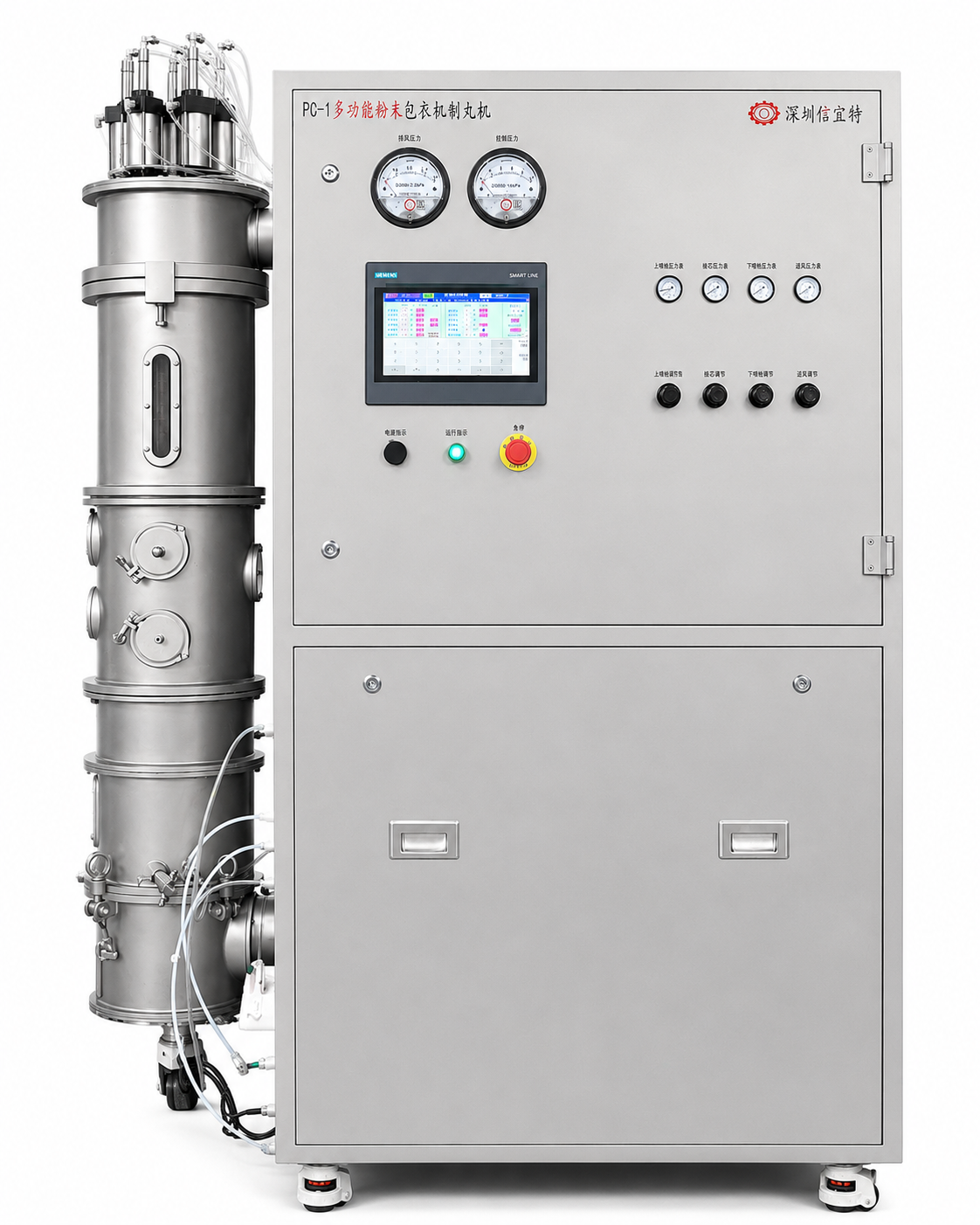
To overcome these challenges, Xinyite has developed a Multifunction Fluid Bed Processor integrated with Tangential Spray (Rotor Pellet Processing) technology, enabling granulation, powder coating, film coating, and microencapsulation processes within a single system.
Micronized Particle Processing Capability
The Xinyite Tangential Spray system is specifically designed to process:
- Micronized API powders.
- Ultra-fine API particles ranging from 20–50 μm.
- Powder blends with poor flowability.
- Highly bitter APIs requiring taste masking.
Through the combination of:
- High-speed rotor technology.
- Uniform hot-air distribution.
- Precision spray systems.
- Optimized processing chamber design.
Ultra-fine API particles are maintained in a stable movement state, allowing polymers to be deposited uniformly on each particle surface while minimizing excessive agglomeration.
Applications in Taste Masking and Microencapsulation
This technology is particularly suitable for projects involving:
- Taste Masking.
- Microencapsulation.
- Moisture Protection.
- Controlled Release.
- Particle Engineering.
Commonly used polymers include:
- Eudragit E PO.
- Ethylcellulose.
- HPMC.
- HPMCP.
- Polyvinyl Acetate.
After coating, the active ingredient is encapsulated within a thin polymer layer that helps:
- Reduce direct contact with taste receptors.
- Improve patient acceptability, especially for pediatric formulations.
- Enhance API stability.
- Improve flowability and tablet compressibility.
Advantages Over Conventional Pellet Coating Technology
Many conventional coating systems require sugar spheres or MCC pellets as carrier cores for active ingredients. In contrast, Xinyite’s Tangential Spray technology enables direct coating of micronized API particles without the need for intermediate core materials.
This approach offers several advantages:
- Higher active ingredient loading.
- Reduced excipient usage.
- Simplified manufacturing processes.
- Shorter formulation development time.
- Well aligned with next-generation pharmaceutical product development trends.
Current development trends indicate a growing demand for microencapsulation and direct taste-masking technologies applied directly to active pharmaceutical ingredient particles. With its capability to process micronized particles in the 20–50 μm range, Xinyite’s Tangential Spray technology provides an effective solution for modern pharmaceutical formulation research and development projects.
 |
 |
 |
 |
Active Pharmaceutical Ingredients Commonly Processed Using Powder Coating Technology
Ibuprofen
- Taste masking for chewable tablets.
- Taste masking for pediatric granules.
- High-dose ODT formulations.
Clarithromycin
- Pediatric oral suspensions.
- Orally disintegrating tablets.
Azithromycin
- Taste masking for oral suspension formulations.
Cetirizine Hydrochloride
- Chewable tablets.
- Orally disintegrating tablets.
Dextromethorphan
- Dry syrup formulations.
- ODT formulations.
Representative Patents on Powder Coating and Taste Masking Technologies
EP1166777A1 – Taste Masked Pharmaceutical Particles
Describes the direct polymer coating of active pharmaceutical ingredient particles to create a complete taste-masking barrier.
US8993041B2 – Taste Masked Active Pharmaceutical Powder Compositions
Applies fluid bed coating technology to produce taste-masked API powders with small particle sizes and high coating uniformity.
EP0302900B1 – Taste-Masked Pharmaceutical Compositions
Describes polymer-based microencapsulation technology for chewable tablets and orally disintegrating tablets (ODTs).
US4800087 – Taste-Masked Pharmaceutical Composition
One of the foundational patents in the field of taste masking using polymer coating technology.
Development Trend: From Sugar Spheres to Powder Coating
Traditional approach:
Sugar Sphere → Drug Layering → Polymer Coating
Modern approach:
Micronized API → Powder Coating → Finished Product
Benefits:
- Higher active ingredient loading.
- Reduced excipient usage.
- Shortened manufacturing process.
- Lower production costs.
- Ideal for ODT and chewable tablet formulations.
- Improved patient experience.
Conclusion
Tangential Spray Powder Coating is becoming a key technology in the fields of Taste Masking, Microencapsulation, and Particle Engineering. Its ability to directly coat micronized API particles ranging from 20–50 μm enables the formation of a uniform polymer layer, improving taste-masking performance, enhancing stability, and optimizing formulation development.
With its Multifunction Fluid Bed Processor integrated with Tangential Spray technology, Xinyite provides a comprehensive solution for Powder Coating, Taste Masking, Microencapsulation, and Controlled Release Coating applications, meeting the growing demands of modern pharmaceutical R&D centers and manufacturing facilities.
