

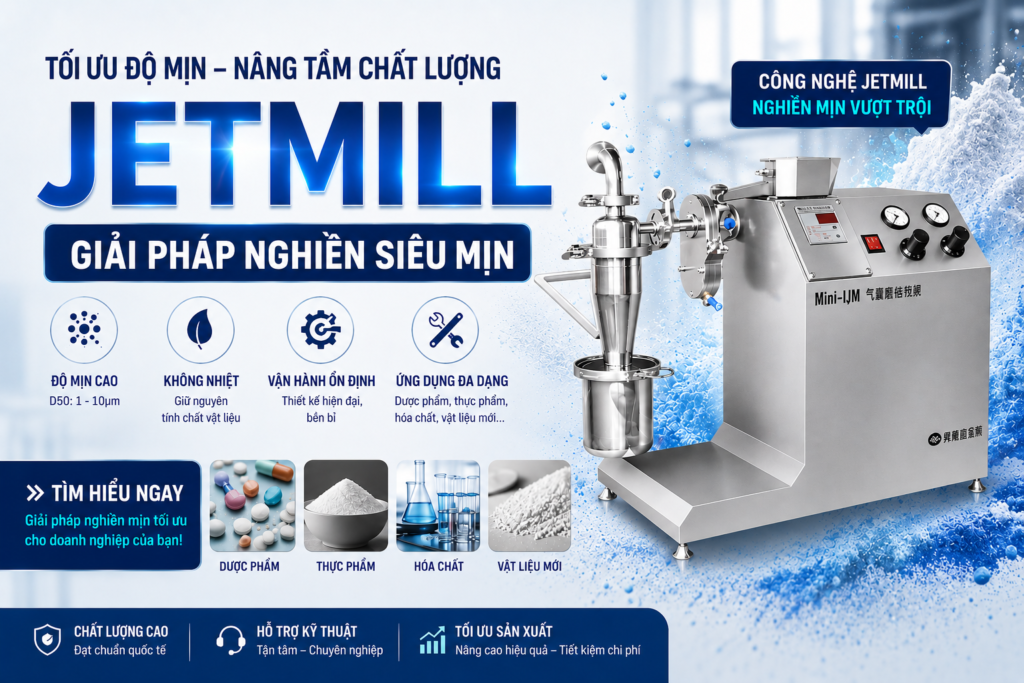
In the modern pharmaceutical industry, ultra-fine grinding technology plays a crucial role in improving drug quality, enhancing the solubility of active pharmaceutical ingredients (APIs), and optimizing the body’s absorption efficiency. Especially for poorly water-soluble APIs, controlling particle size at the micron level is a key factor that directly affects therapeutic effectiveness.
For this reason, pneumatic jet mills (Jet Mills) are increasingly being widely applied in pharmaceutical manufacturing plants, dietary supplement production, and high-tech chemical industries. They are considered one of the most advanced ultra-fine grinding solutions available today due to their precise particle size control capability. Compared with conventional mechanical grinding equipment such as hammer mills, ball mills, or knife mills, pneumatic jet mills offer significant advantages in achieving finer particle sizes, generating lower heat during operation, minimizing metal contamination, and complying with stringent GMP standards.
What Is a Pneumatic Jet Mill?
A pneumatic jet mill is a grinding system that utilizes compressed air or superheated steam accelerated through Laval nozzles to generate extremely high-velocity airflow, typically reaching or even exceeding the speed of sound.
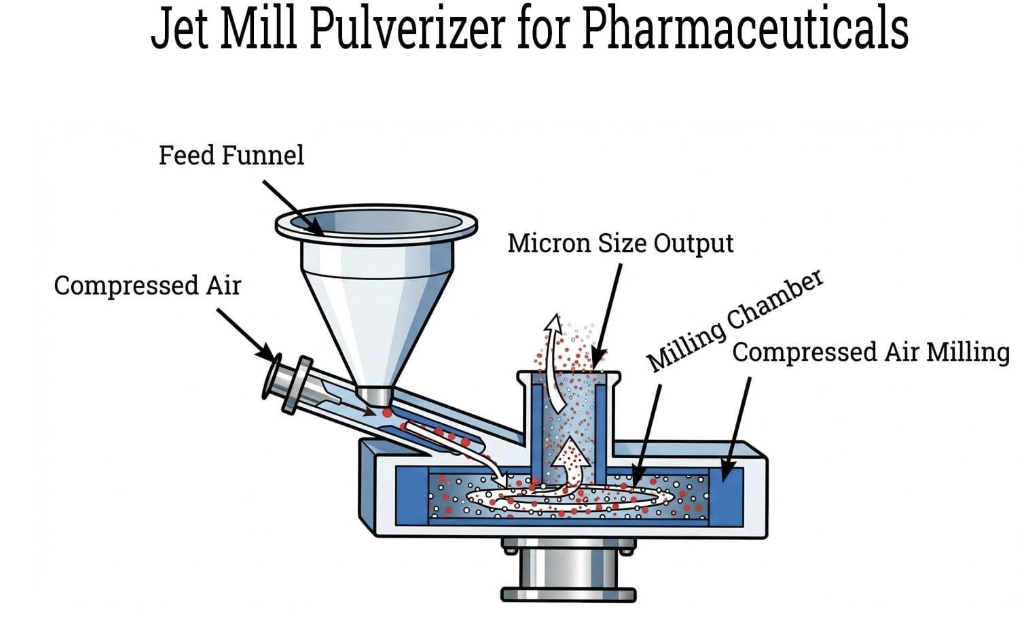
A typical Jet Mill system consists of:
- Air compressor
- Air drying system
- Grinding chamber
- High-velocity air nozzles
- Air classifier system
- Cyclone product collector
- Dust filtration system
Ultra-Fine Grinding Solutions for Pharmaceutical Manufacturers
For pharmaceutical, dietary supplement, and high-tech chemical manufacturers, investing in ultra-fine grinding systems not only improves product quality but also creates long-term competitive advantages.
Today, many manufacturers are adopting integrated grinding, mixing, and classification solutions in order to:
- Increase production efficiency
- Reduce material loss
- Improve quality control
- Comply with international GMP standards
Businesses can also explore additional fine grinding and ultra-fine grinding equipment solutions at XinyiTe Vietnam
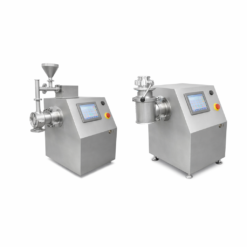
Pulverization / Micronization / Mixing
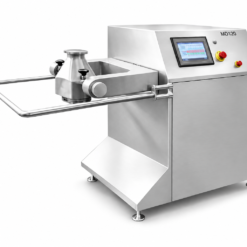
Pulverization / Micronization / Mixing
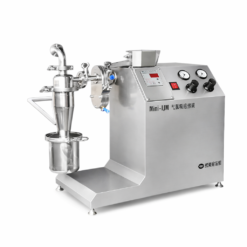
Pulverization / Micronization / Mixing
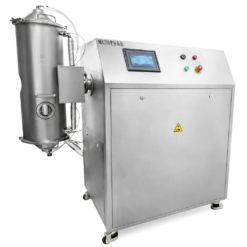
Pulverization / Micronization / Mixing
Operating Principle of a Pneumatic Jet Mill
A pneumatic jet mill operates by introducing compressed air or inert gas into the grinding chamber through high-pressure nozzles. The accelerated airflow generates an ultra-high-speed vortex inside the grinding chamber.
After being fed into the system, the material particles continuously collide with one another under the force of the high-velocity airflow. These repeated particle-to-particle impacts gradually reduce the particle size to an ultra-fine level.
Once the required particle size is achieved:
- Fine particles are discharged through the classifier system
- Coarse particles are returned to the grinding chamber for further processing
One of the most important advantages of a Jet Mill is that there are almost no moving grinding components directly contacting the material. This significantly reduces heat generation and helps prevent metal contamination in the final product.
The Role of Pneumatic Jet Mills in the Pharmaceutical Industry
Enhancing API Solubility
Many pharmaceutical active ingredients today have poor water solubility. When these materials are ground to an ultra-fine particle size, their surface area increases significantly, which helps to:
- Increase dissolution rate
- Improve bioavailability
- Enhance drug absorption efficiency
According to research on API micronization using Jet Mill technology, reducing particle size to the micron level can significantly improve the dissolution performance of poorly water-soluble drugs.
Ensuring Uniform Particle Size Distribution
In the production of tablets, capsules, and inhalation drugs, particle size uniformity is an extremely important factor.
Pneumatic jet mills are capable of:
- Controlling narrow particle size distribution
- Ensuring uniform API dispersion
- Optimizing the tablet compression process
- Maintaining stable finished product quality
This is why Jet Mills are widely used in the production of APIs, inhalation drugs, and high-tech pharmaceutical products.
Minimizing Metal Contamination and Cross-Contamination
Traditional mechanical grinding systems often generate metal particles due to friction between the material and grinding components.
In contrast, Jet Mills utilize air-driven particle collision mechanisms, resulting in minimal mechanical contamination. This is particularly important for:
- Injectable drugs
- Inhalation pharmaceuticals
- Biopharmaceutical products
- High-purity APIs
Many modern Jet Mill systems are also manufactured using 316L stainless steel, engineering ceramics, or PTFE materials to comply with stringent GMP and FDA requirements.
Suitable for Heat-Sensitive Materials
Certain pharmaceutical active ingredients are highly sensitive to heat and may degrade when exposed to elevated temperatures. Since Jet Mills do not rely on mechanical grinding mechanisms, they generate very little frictional heat during operation.
According to ultra-fine grinding technology specialists, Jet Mills are an ideal solution for processing heat-sensitive materials, waxy substances, and thermally unstable active ingredients.
Outstanding Advantages of Pharmaceutical Pneumatic Jet Mills
Ultra-Fine Particle Size
Pneumatic jet mills are capable of producing ultra-fine particle sizes ranging from 1–10 µm, or even smaller depending on the application.
This helps to:
- Increase API dissolution rate
- Improve particle dispersion
- Enhance drug absorption efficiency
GMP Compliance
Modern Jet Mill systems are designed with:
- Fully enclosed structures
- Easy CIP/SIP cleaning capability
- Cross-contamination prevention
- Automatic PLC control systems
- Integrated dust collection systems
Many systems also comply with FDA 21 CFR Part 11 and GMP requirements for pharmaceutical manufacturing.
Oil-Free and Contamination-Free Operation
Compressed air systems used in pharmaceutical manufacturing require clean air that complies with ISO 8573-1 Class 0 standards to prevent oil contamination in the product.
According to pharmaceutical compressed air standards, even extremely small amounts of oil contamination can negatively affect drug quality and violate GMP requirements.
Reduced Maintenance Costs
Compared with conventional mechanical mills, Jet Mills contain fewer moving parts, which helps to:
- Reduce component wear
- Lower maintenance costs
- Extend equipment lifespan
- Minimize production downtime
Applications of Pneumatic Jet Mills in Pharmaceutical Manufacturing
Today, pneumatic jet mills are widely used across many pharmaceutical applications.
API Grinding
This is the most common application of Jet Mill technology in the pharmaceutical industry.
The equipment helps to:
- Precisely control particle size
- Improve API dissolution performance
- Maintain high product purity
Ultra-Fine Traditional Medicine and Herbal Processing
Pneumatic jet mills are also used for grinding:
- Traditional herbal medicines
- Medicinal herbs
- Dietary supplement powders
- Natural extracts
Due to the low-temperature grinding process, natural active compounds can be preserved more effectively.
Pharmaceutical Nanotechnology
In modern pharmaceutical nanotechnology development, Jet Mills play an important role in producing ultra-fine materials for:
- Nano curcumin
- Nano herbal products
- Nano drug delivery systems
Important Factors When Selecting a Pneumatic Jet Mill
When investing in an ultra-fine grinding system for pharmaceutical manufacturing, companies should carefully evaluate several technical factors.
Grinding Capacity
The appropriate system should be selected based on production scale:
- Laboratory-scale machines
- Pilot-scale systems
- Large industrial production systems
Output Particle Size
Manufacturers should clearly define:
- Target particle size
- Particle size distribution
- API quality requirements
Construction Materials
In pharmaceutical manufacturing, product-contact materials commonly include:
- SUS304 stainless steel
- SUS316L stainless steel
- Engineering ceramics
- PTFE materials
These materials help prevent metal contamination and ensure GMP compliance.
Clean Compressed Air System
This is an extremely critical factor in pharmaceutical production.
The compressed air system should provide:
- Oil-free air
- HEPA filtration
- Humidity control
- ISO 8573-1 Class 0 compliance
Current Trends in Ultra-Fine Grinding Technology
In the modern pharmaceutical industry, manufacturers are increasingly prioritizing integrated pneumatic jet mill systems featuring:
- Automatic particle classification
- Intelligent PLC control
- Real-time temperature monitoring
- Online pressure monitoring
- Nitrogen explosion-proof systems
In addition, fully enclosed grinding technology is becoming increasingly popular to meet the stringent requirements of next-generation pharmaceutical manufacturing.
Some advanced Jet Mill systems can also be directly integrated with production lines for:
- Powder blending
- Granulation
- Film coating
- Automatic capsule filling
This helps optimize the entire pharmaceutical manufacturing process.
Tin Nghi Dac Company – Ultra-Fine Grinding Solutions for the Pharmaceutical Industry
Pneumatic jet mills are an essential technology in modern pharmaceutical manufacturing. With advantages such as ultra-fine grinding capability, minimal contamination risk, precise particle size control, and GMP compliance, Jet Mill systems are becoming the preferred solution for next-generation pharmaceutical factories.
As the pharmaceutical industry continues to demand higher product quality and purity standards, investing in advanced pneumatic jet mill systems not only improves manufacturing efficiency but also helps companies produce safer, more stable, and highly competitive pharmaceutical products.
Tin Nghi Dac Pharmaceutical Equipment Co., Ltd.
Tax Code: 3703422032
Office phone: (+84)28 66719989
Mobile: (+84)329 280 289
Email: info@xinyite.com.vn
Address: 49C D11 Street, Group 18, Quarter 4, An Phu Ward, Ho Chi Minh City, Vietnam.
