


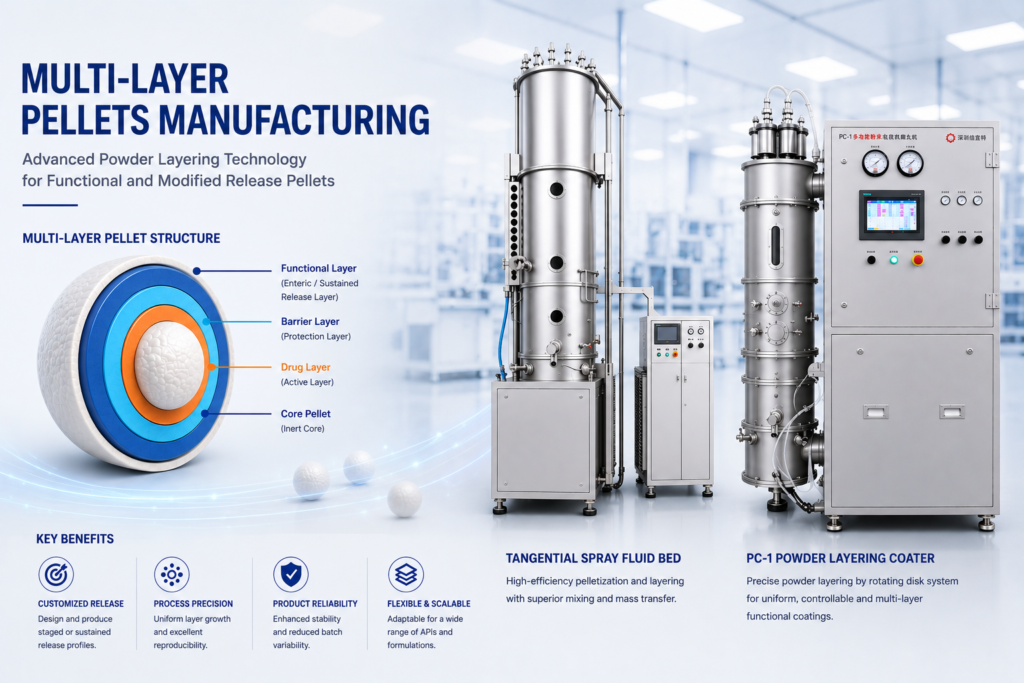
Powder Layering Technology: Extended-Release Metoprolol Succinate Pellets
1. What is Powder Layering?
Powder Layering is a pellet manufacturing technology in which a binder solution is sprayed while active pharmaceutical ingredient (API) powder is simultaneously layered onto the surface of starter pellets. This process is commonly performed using Tangential Spray Fluid Bed Systems or Rotor Pellet Processors, enabling the formation of a uniform drug layer around each pellet core.
Compared with conventional Drug Solution Layering technology, Powder Layering allows significantly higher drug loading on pellets, making it particularly suitable for formulations containing high API concentrations or poorly soluble active ingredients.
Working Principle
During operation, starter pellets are continuously fluidized and circulated within the processing chamber through the combined action of process air and a high-speed rotor. A binder solution is sprayed onto the pellet surface while API powder is continuously fed into the layering zone. The powder adheres to the wetted pellet surface and gradually forms uniform material layers around each pellet.
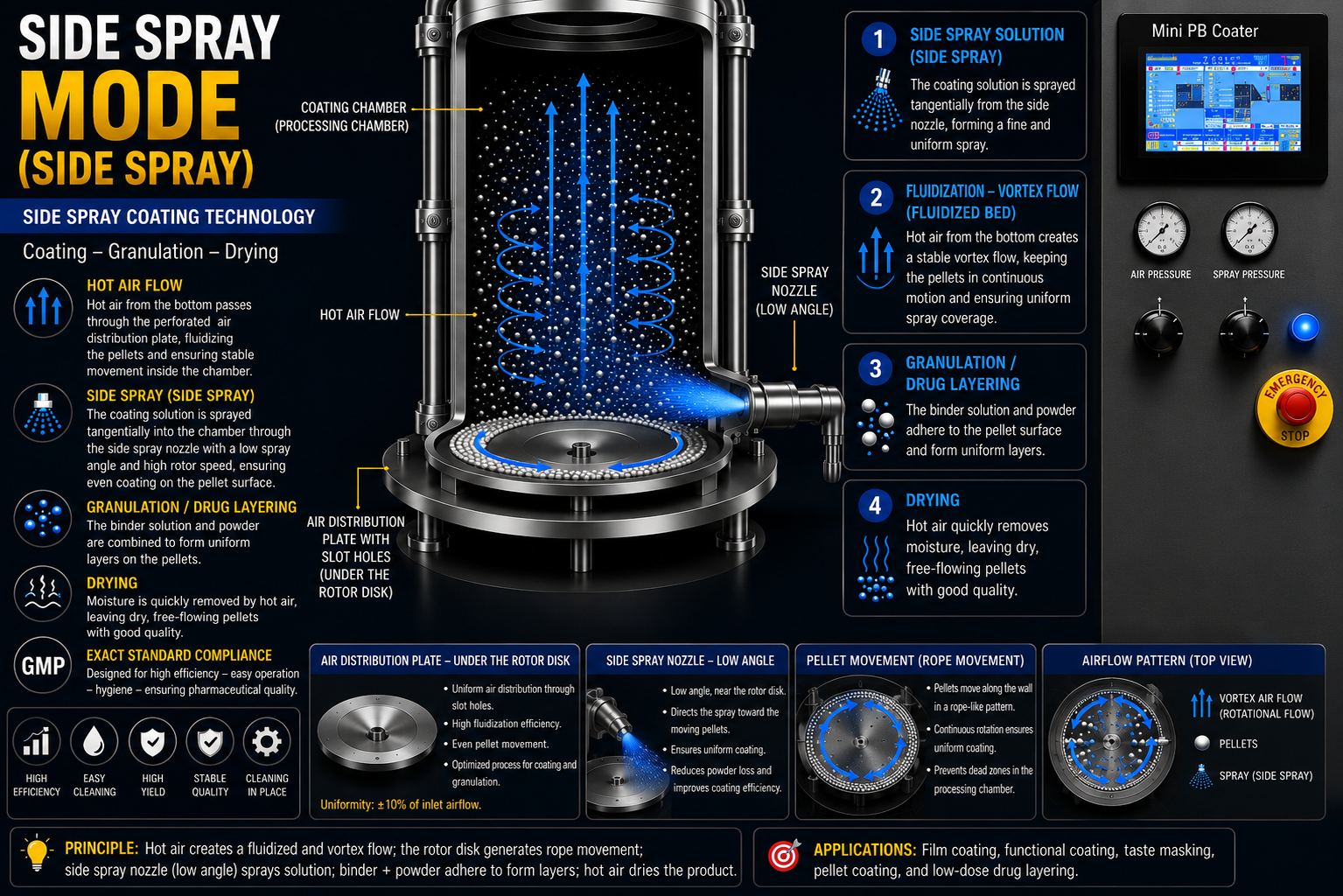
After the target weight gain is achieved, the pellets are dried and can subsequently undergo functional coating processes such as enteric coating or extended-release coating.
Advantages of Powder Layering Technology
- Higher drug loading on pellets.
- Excellent content uniformity.
- High product recovery efficiency.
- Reduced solvent consumption compared with drug solution layering technology.
- Suitable for poorly water-soluble active ingredients.
- Compatible with subsequent functional coating processes.
Applications in the Pharmaceutical Industry
Powder Layering technology is widely used for the production of:
- Extended-release pellets.
- Enteric-coated pellets.
- MUPS (Multiple Unit Pellet System).
- Pellet-filled capsules.
- Direct-compression pellet tablets.
- Taste-masking powder coatings.
- Taste-masked suspension formulations.
Many pharmaceutical products are manufactured using this technology, including Omeprazole, Esomeprazole, Lansoprazole, Rabeprazole, Tamsulosin, Metoprolol Succinate, and numerous other extended-release formulations.
Extended-Release Metoprolol Succinate Pellets
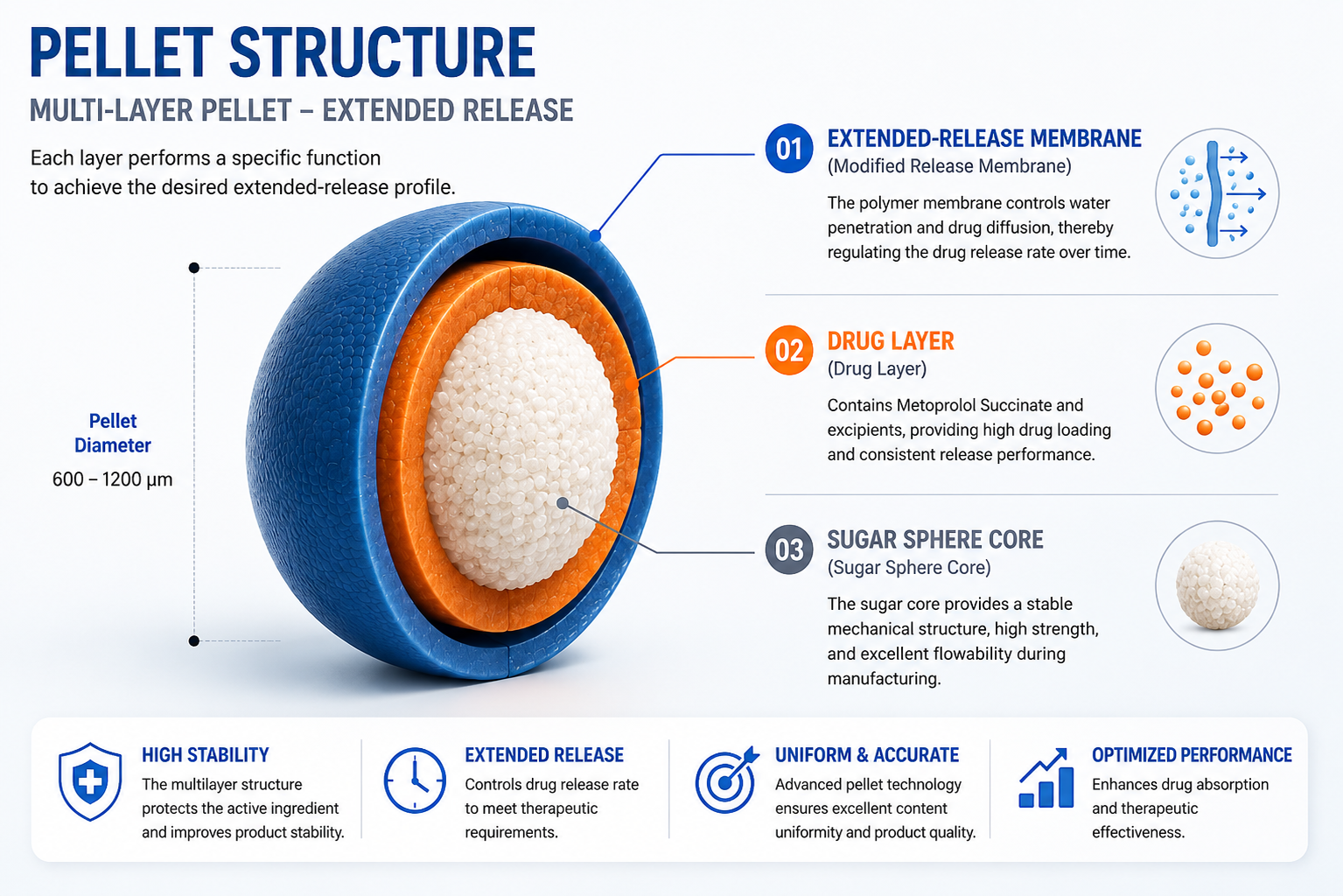
Pellet Structure
Modified Release Membrane
Metoprolol Succinate Drug Layer
Sugar Sphere Core
Each layer performs a specific function to achieve the desired extended-release profile.
Materials
Sugar Sphere Core
- Sugar Spheres (20–25 mesh)
Drug Layer
- Metoprolol Succinate
- PVP K30
- Purified Water
Extended-Release Membrane
- Kollicoat® SR 30D
- Talc
- Titanium Dioxide (Optional)
- Purified Water
Equipment
Xinyite Multifunction Fluid Bed Processor
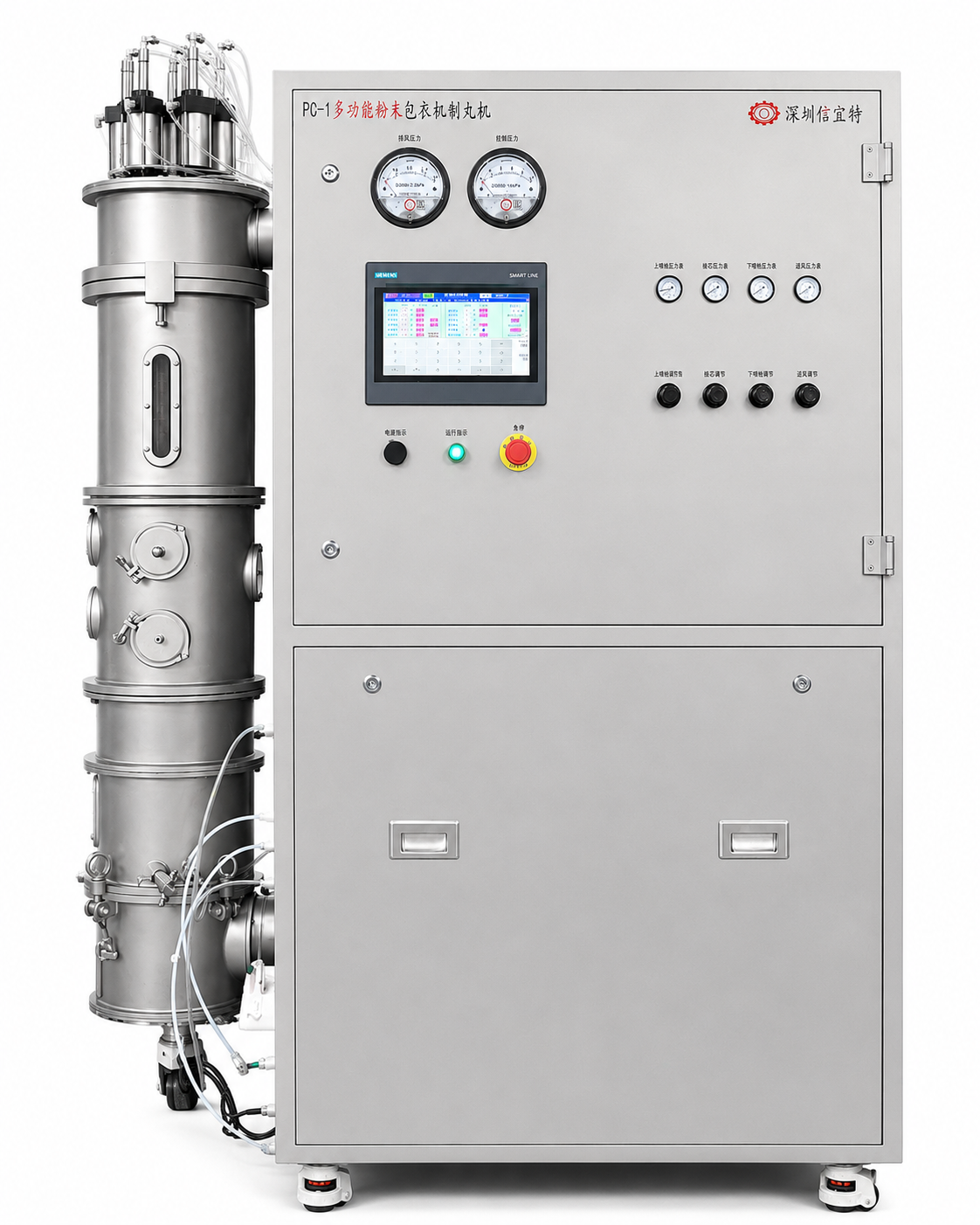

Operating Mode:
Tangential Spray (Rotor Pellet Processor)
Applications:
- Drug Layering
- Functional Coating
- Sustained-Release Coating
- Pellet Manufacturing
Manufacturing Process
Step 1. Loading Starter Pellets
Sugar sphere cores are loaded into the processing chamber of the fluid bed system equipped with a rotating rotor disc.
The rotor motion generates a stable spiral flow pattern, ensuring uniform pellet mixing and consistent exposure to the spray zone.
Typical Rotor Speed: 250–450 rpm
Step 2. Drug Layering Process
The drug suspension is prepared using Metoprolol Succinate and PVP K30.
Example Formulation
Metoprolol Succinate …………. 90 parts
PVP K30 ……………………………… 5 parts
Purified Water ………………….. q.s.
The suspension is continuously stirred and sprayed onto the surface of the sugar sphere cores through a Tangential Spray nozzle.
Typical Process Parameters
Inlet Air Temperature: 45–55°C
Product Temperature: 35–40°C
Spray Pressure: 1.0–1.5 bar
Rotor Speed: 250–450 rpm
The tangential movement of the pellets promotes uniform drug distribution and minimizes agglomeration.
Step 3. Drying
After drug layering, the pellets are dried directly in the same processing unit.
Typical Conditions:
Product Temperature:
- 35–40°C
Final Moisture Content:
- Below 2.0%
The resulting pellets exhibit excellent flowability and a narrow particle size distribution.
Step 4. Extended-Release Coating
The extended-release coating suspension is prepared using Kollicoat® SR 30D.
Typical Composition:
- Kollicoat® SR 30D …………… 100 parts
- Talc ………………………………….. 30 parts
- Titanium Dioxide …………….. 5 parts
- Purified Water ………………… q.s.
Kollicoat® SR 30D is an aqueous polyvinyl acetate dispersion specifically designed for sustained-release pharmaceutical formulations.
Compared with traditional ethylcellulose systems, Kollicoat® SR 30D offers several advantages:
- Higher film flexibility.
- Better coating uniformity.
- Reduced risk of film cracking.
- Simpler formulation design.
- Improved long-term dissolution stability.
The coating suspension is applied using Tangential Spray technology.
Typical Coating Conditions:
Inlet Air Temperature:
- 45–55°C
Product Temperature:
- 35–40°C
Rotor Speed:
- 300–500 rpm
Atomizing Air Pressure:
- 1.2–2.0 bar
Coating Weight Gain:
- 8–15%
The final coating membrane controls water penetration and drug diffusion, thereby regulating the release rate of Metoprolol Succinate over an extended period.
Advantages of Tangential Spray Technology
Compared with conventional coating systems, Tangential Spray technology offers:
- Highly spherical pellets.
- Uniform drug distribution.
- High coating efficiency.
- Reduced agglomeration.
- Precise control of coating thickness.
- Shorter production time.
- Easy scale-up from R&D to commercial manufacturing.
Applications
This technology is suitable for manufacturing:
- Extended-Release Metoprolol Succinate Pellets.
- Extended-Release Tamsulosin Pellets.
- Enteric-Coated Omeprazole Pellets.
- Enteric-Coated Esomeprazole Pellets.
- Multiparticulate Extended-Release Pellet Systems.
References
1. WO2007097770A1 / US20070202172A1
Metoprolol Succinate E.R. Tablets and Methods for Their Preparation
(AstraZeneca / Hässle)
2. US7314640
3. WO2012052834A2
Multiple Unit Particulate System Comprising Metoprolol Succinate
