


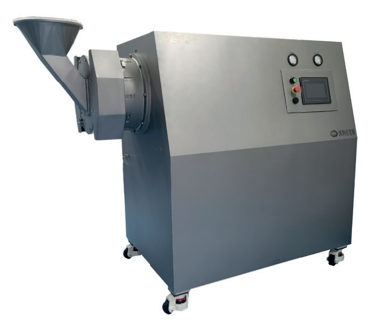
Applications: This equipment is utilized for pellet formation via the planetary extrusion-spheronization method. It is an ideal solution for preparing both blank pellets and drug-loaded cores in the pharmaceutical, food, and chemical industries.
Operating Principle: Raw materials and excipients are uniformly mixed with a wetting agent to form a wet mass. Once fed into the extrusion chamber, the material is instantaneously compressed by rollers performing a circular (planetary) motion against a perforated screen. This pressure forces the material through the screen to form dense, cylindrical extrudates. These extrudates enter the spheronization bowl, where the rotation of the friction plate—combined with shear, centrifugal, and frictional forces—transforms them into uniform spherical pellets.
Key Features:
-
Wide Applicability: Effectively processes standard materials as well as heat-sensitive substances and those involving volatile organic solvents.
-
Planetary Structure (Patent No.: ZL 2015 2 0098645.3): The planetary design minimizes extrusion resistance and material compression time while providing high instantaneous pressure, resulting in high throughput and efficiency.
-
Cooling System: Rollers feature an axial cooling design to lower roller temperature and reduce heat generation during the extrusion process.
-
Annular Screen Plate: The integrated annular design of the screen ensures high structural strength and low roller resistance, facilitating optimal extrusion.
-
Multiple Screen Options: Various screen diameters and thicknesses are available to produce micro-pellets from 0.2mm to 3.0mm.
-
Low Material Residue: The planetary extrusion process leaves virtually no residual material in the chamber, preventing waste and saving costs.
-
GMP Compliance: Features three-level password authorization. Process parameters are fully automated via PLC, with online data storage and USB export functionality.
Specifications, Model and Main Technical Parameters:
| Model | RE150 (Vertical) | RE200 (Vertical) | RE250 (Vertical) | RE350 (Vertical) | RE350 (Horizontal) | RE500 (Horizontal) | RE750 (Horizontal) |
|---|---|---|---|---|---|---|---|
| Capacity (kg/h) | 1-6 | 10-60 | 50-100 | 80-200 | 80-200 | 120-500 | 300-1500 |
| Extrusion Screen Diameter (mm) | 150 | 200 | 250 | 350 | 350 | 500 | 750 |
| Screen Mesh Size (mm) | 0.2-3.0 | 0.2-3.0 | 0.2-3.0 | 0.2-3.0 | 0.2-3.0 | 0.2-3.0 | 0.2-3.0 |
| Extrusion Speed (rpm) | 3-50 | 3-50 | 3-50 | 3-50 | 3-50 | 3-50 | 3-50 |
| Power Supply | 220V/50Hz
1P 3W |
380V/50Hz
3P 5W |
380V/50Hz
3P 5W |
380V/50Hz
3P 5W |
380V/50Hz
3P 5W |
380V/50Hz
3P 5W |
380V/50Hz
3P 5W |
| Total Power (kW) | 0.75 | 2.2 | 3.7 | 7.5 | 7.5 | 37 | 75 |
| Overall Dimensions (mm) | 600×1100×1200 | 900×1300×1300 | 1000×1400×1450 | 1880×850×1550 | 1880×850×1550 | 200×1600×1650 | 1500×1600×2300 |
| Machine Weight (kg) | 25 | 250 | 300 | 400 | 400 | 1700 | 2200 |
Note: Capacity is based on 1.0mm screen mesh and wet materials.
Reviews
There are no reviews yet.